
Four Horse Trailers
Ten four horse trailers, mostly gooseneck with a bumper pull or two among them, and several fitted with dressing rooms or set up as tack and stock combos. Sooner, Cherokee, Jamco, C&C, Hart, Lakota, Trails West and Bloomer are the makes represented, across model years 2000 to 2020 and a price band of roughly $11,600 to $34,000. This is the largest capacity Atlas stocks, so the selection is small and changes often.
Delivery to the Lower 48 is built into the listed price and Puerto Rico is a flat $550, usually 4 to 10 days after your direct bank transfer clears. Returns are open for 30 days.
Showing all 10 results
-
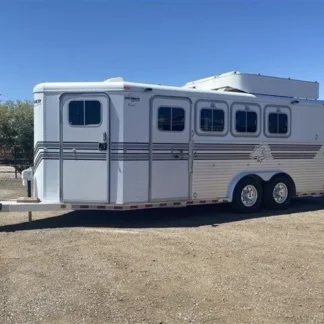 Four Horse Trailers
2000 Sooner 4 Horse Bumper Pull with Extra-Large Dressing Room
$11,996.00 Add to cart -
 Four Horse Trailers
2004 Cherokee 4 Horse Gooseneck Trailer with 4 ft Dressing Room
$12,400.00 Add to cart -
 Four Horse Trailers
2005 Jamco 4HGN Four Horse Gooseneck Trailer with Front and Rear Tack
$14,076.00 Add to cart -
 Four Horse Trailers
2006 C&C 4 Horse Gooseneck Trailer, All Aluminum with 22 ft Stock Area
$11,600.00 Add to cart -
 Four Horse Trailers
2008 C and C 4 Horse Bumper Pull Trailer with Front and Rear Tack
$13,596.00 Add to cart -
 Four Horse Trailers
2016 Hart Ultimate 4 Horse Bumper Pull Trailer with 6 ft Hay Pod
$16,720.00 Add to cart -
 Four Horse Trailers
2018 Lakota 84HBPSL 4 Horse Aluminum Trailer with 2 ft Short Wall
$17,596.00 Add to cart -
 Four Horse Trailers
2019 Trails West Classic II 4 Horse Trailer with Convenience Package
$11,920.00 Add to cart -
 Four Horse Trailers
2020 Bloomer 4 Horse Stock Combo Trainer Tack Horse Trailer
$34,000.00 Add to cart -
 Four Horse Trailers
2020 Trails West Sierra 4 Horse Gooseneck with Side Tack Room
$18,320.00 Add to cart
Showing all 10 results
Four Horse Trailers and the Truck That Has to Pull Them
At four stalls a horse trailer becomes a serious piece of equipment. Empty weights climb, lengths stretch well past 20ft, and the margin between what a trailer can hold and what a tow vehicle can legally move narrows fast. Buyers at this size are usually running a training barn, a breeding operation, a hauling business or a family that competes seriously, and the priorities shift accordingly: durability, loading speed and storage start to outrank purchase price.
Why almost everything here is a gooseneck
A bumper pull carries its tongue weight behind the tow vehicle's rear axle, which introduces leverage that grows with length and load. Past roughly three horses that geometry stops being comfortable. A gooseneck puts the pin directly over the rear axle instead, so the load presses down through the truck's strongest point, sway largely disappears and the trailer can be longer without becoming a handful in a crosswind. The trade is that you need a pickup with a bed-mounted hitch, and you need to respect its pin weight rating rather than just its towing figure.
Stock combo or individual slant stalls
A four horse slant gives each animal its own defined space with dividers that stay put, which is what most competition haulers want. A stock combo uses removable or swinging dividers behind a front tack area, turning the same trailer into open space for loose stock, gear or four horses hauled loose. Combos are quicker to load and easier to clean; dedicated slants travel better with horses that need separating. Watch stall width on four-across slants, because manufacturers vary considerably in how generous the last stall is.
Dressing rooms, tack and payload discipline
A front dressing room on a gooseneck four horse gives real storage for saddles, blankets, feed and a water supply. It also puts weight forward of the axles, which raises pin weight, and pin weight is exactly the number that eats a truck's payload allowance. Load heavy items low and near the axles where you can, and weigh the loaded rig once rather than guessing. Rear or mid tack rooms keep the weight closer to the axles but reduce stall count or usable length.
Ventilation, flooring and drainage
Four horses generate a lot of heat and ammonia in an enclosed shell, so roof vents, drop windows and side airflow matter far more here than on a two horse trailer. On the floor, look at how liquid actually leaves the trailer: proper drainage, sealed seams and mats that can be lifted for cleaning are what keep an aluminum or wood floor alive for twenty years. A floor that has never been dried out underneath is the single most expensive fault on an older horse trailer.
Assessing an older large trailer
With model years reaching back to 2000, read every listed detail on the coupler and safety chains, the axle and brake configuration, the condition of the roof and its seams, and the tires including date codes. Ask about service records for bearings and brakes. Hinges, latches and divider pins take constant punishment on a four horse and are cheap to replace but tell you honestly how hard the trailer worked. Request additional photographs of anything that matters to you and we will send them.
Price, payment and getting it home
Expect to see figures from about $11,600 to $34,000 in this category, each one already covering road transport to any Lower 48 address, with Puerto Rico at a flat $550 and delivery normally falling 4 to 10 days after a direct bank transfer clears. Full haulage terms are on the shipping policy page. If four stalls is more than you need, the three horse trailers cover the step below. To talk through a specific unit, use the contact page or call (870) 212-9785 during business hours.