
Two Horse Trailers
Showing 25–35 of 35 results
-
 Two Horse Trailers
2015 4 Star 2 Horse Slant Load Bumper Pull with Rear Tack Room
$10,000.00 Add to cart -
 Two Horse Trailers
2016 Shadow 2HBP All-Aluminum 2 Horse Bumper Pull Trailer
$6,800.00 Add to cart -
 Two Horse Trailers
2016 Shadow 2STW-BP 2 Horse Bumper Pull with 4 ft Short Wall
$8,080.00 Add to cart -
 Two Horse Trailers
2018 Lakota 2HBPST 2 Horse Aluminum Bumper Pull, 4 ft Dressing Room
$10,000.00 Add to cart -
 Two Horse Trailers
2019 Sundowner Charter 2 Horse Bumper Pull, Warmblood Size 16 ft Floor
$11,920.00 Add to cart -
 Two Horse Trailers
2019 Trailers USA 2HSLBPDLX Aluminum 2 Horse Bumper Pull Trailer
$9,200.00 Add to cart -
 Two Horse Trailers
2021 Titan 2 Horse Slant Load Bumper Pull with Dressing Room
$10,796.00 Add to cart -
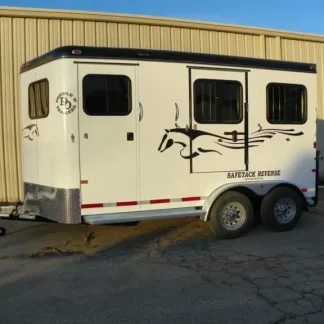 Two Horse Trailers
2022 Double D Reverse Slant 2 Horse Bumper Pull with Two Ramps
$15,999.00 Add to cart -
 Two Horse Trailers
2023 4-Star 2+1 Gooseneck Horse Trailer with WERM Floor, 23 ft
$20,000.00 Add to cart -
 Two Horse Trailers
2023 Shadow 2HSSR Aluminum 2 Horse Trailer with 16 ft 6 in Box
$10,400.00 Add to cart -
 Two Horse Trailers
2024 Shadow 2 Horse Aluminum Bumper Pull with 2 ft Dressing Room
$16,240.00 Add to cart
Showing 25–35 of 35 results
Fitting a Two Horse Trailer to Your Horses and Your Hitch
Two horse trailers are the busiest corner of the horse market because they suit the way most people actually ride: one or two animals, a local show or trailhead, a truck or SUV that also has to do everyday duty. Within that simple brief there is a surprising amount of variation. The listings here cross three decades of model years, both hitch types, both loading layouts, and everything from a bare-bones stock trailer to a weekender with a finished dressing room.
Slant load or straight load
In a slant load the stalls sit at an angle across the trailer, which packs two horses into a shorter shell and gives many horses a more natural way to brace against motion. Stall length is the catch: a slant stall that suits a 15 hand quarter horse can be tight for a 16.2 hand warmblood, and the divider position is not always adjustable. A straight load puts horses nose-forward in their own bays, which is kinder to long-bodied and tall horses and much easier to unload in a hurry, though the trailer is usually heavier for the same capacity. Horses that have only ever travelled one way sometimes object strongly to the other, so factor in what yours already knows.
Hitch type at this size
Most two horse trailers are bumper pulls, and for good reason. They are lighter, cheaper, easier to store, and a properly set up weight-distributing hitch on a capable half-ton handles them. Goosenecks at this capacity show up when the owner wants a gooseneck's stability on long hauls or wants the raised nose for tack and sleeping space. The gooseneck needs a pickup with a bed hitch, and pin weight rather than total weight is the number that constrains you.
Interior height, stall length and the tall horse problem
Interior height is measured at the highest point of the roof, and 7ft has become the common figure for anything over about 16 hands. Older trailers frequently sit at 6ft 6in, which is fine for ponies and smaller stock horses and genuinely unsuitable for a big horse that throws its head. Stall length matters just as much: check the listed measurement against your horse's body length, and remember that a horse needs to be able to lower its head to clear its airway on a long trip.
Dressing rooms, tack and weekender packages
A front dressing room turns a trailer into somewhere to store saddles, keep feed dry and change clothes. Weekender packages take that further with a bed, cabinets and sometimes a small galley in the gooseneck nose, which suits multi-day shows without the expense or the weight of full living quarters. Rear tack compartments with saddle racks are the alternative on slant loads and are very convenient at the trailhead, though they eat into stall space.
Construction and what ages
All-aluminum shells stay light and resist corrosion but can fatigue at welds if a trailer has led a hard life. Steel frames with aluminum skin are a common compromise. Whatever the material, the parts that decide a used trailer's future are the floor, the axles and the wiring. Wood floors hide rot under mats, aluminum plank floors corrode from urine at the seams, and bearings and brakes on a trailer that sat for years need attention regardless of mileage. Tire date codes are worth more than tread depth on a trailer that is stored more than it is driven.
Buying and delivery
Listings in this range start around $2,800 and top out near $20,000, and the price shown covers road transport to the Lower 48 with no separate haulage bill; Puerto Rico is a flat $550. Payment is by direct bank transfer, and delivery usually happens within 4 to 10 days of the funds arriving. If you are hauling more than a pair, the three horse selection covers the next size up. Our returns policy gives you 30 days, and anything you want to ask before ordering can go through the contact page or straight to (870) 212-9785.